RESEARCH & EVIDENCE
5-Amino-1MQ Research and What NNMT Inhibition Means
Review how 5-Amino-1MQ inhibits NNMT, what mouse studies measured, and what remains unknown about human use.
What 5-Amino-1MQ is used to study
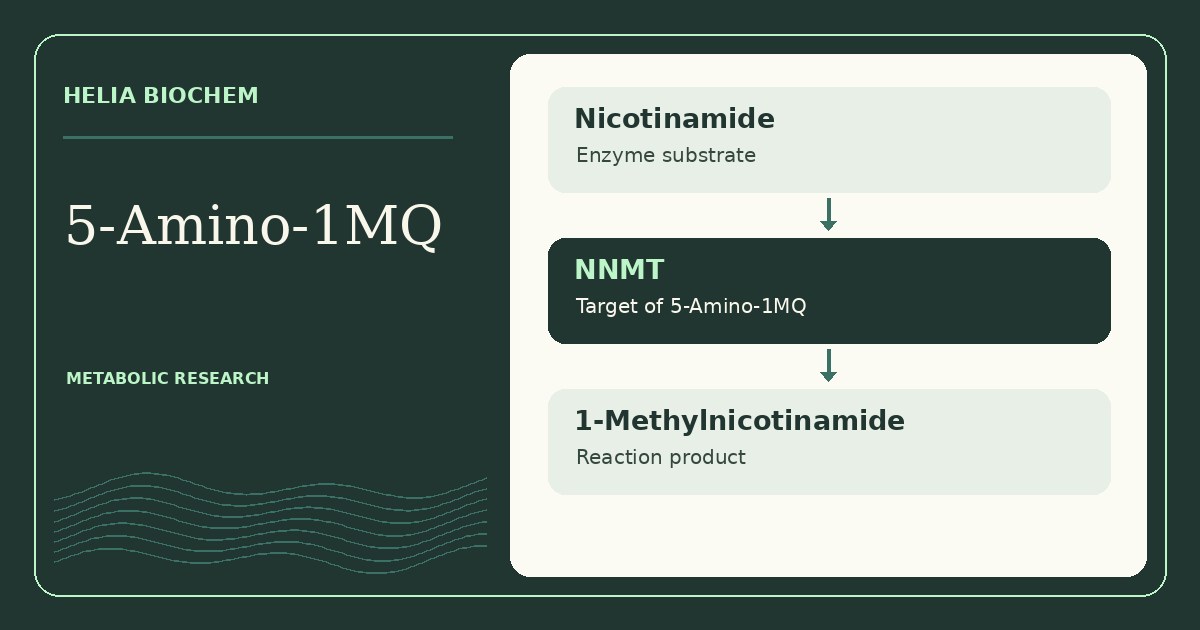
5-Amino-1MQ is the shorthand for 5-amino-1-methylquinolinium, a small molecule studied as an inhibitor of nicotinamide N-methyltransferase (NNMT). NNMT uses S-adenosylmethionine to methylate nicotinamide, producing 1-methylnicotinamide. Researchers study this pathway because nicotinamide also participates in the NAD salvage pathway, and because methyl-donor use can influence cellular metabolism. Inhibiting one enzyme gives researchers a way to probe those connections. Its effects on NAD-related measures can depend on the tissue and model.
What the studies actually measured
The rationale began with research on the target. In a 2014 mouse study, knocking down NNMT protected against diet-induced obesity under the study conditions. Genetic knockdown and treatment with a small molecule are distinct experiments. The first helps test whether the target matters, while the second asks what happens when a specific compound interacts with it.
In a 2018 proof-of-concept study, researchers characterized small-molecule NNMT inhibition in cell experiments and studied 5-Amino-1MQ in diet-induced obese mice. The animal groups were small and the observation period was brief. The study reported differences in body weight and measures involving adipose tissue. Useful follow-up questions include how long those changes persist and whether they recur in a different laboratory or model.
A 2024 follow-up study measured fat-mass gain, glucose handling and liver findings in diet-induced obese mice. It also tested how the molecule reached plasma and tissues in mice under different experimental conditions. These measures give researchers a better account of what happened in that model. They leave human exposure, effectiveness and safety unanswered. A ClinicalTrials.gov search for the compound and two aliases returned zero matching studies when checked on November 21, 2026.
What user reports add
In a public r/Peptides discussion, commenters described little or no noticeable change. One mentioned using the compound alongside MOTS-c, so there was no way to isolate the effect of either compound. In a public GLP-1 Forum discussion, one member reported migraines on two occasions after trying it. These reports describe individual experiences. They provide neither a verified adverse-event rate nor a way to rule out other causes.
The strongest case for using 5-Amino-1MQ in research is as a probe of NNMT and related metabolic pathways. A convincing human evidence base would require a defined formulation, independently characterized exposure, and controlled measurements of outcomes such as body composition and adverse events. For related background, see NAD and nicotinamide redox chemistry. Helia’s 5-Amino-1MQ listing describes the material it offers for laboratory research.