RESEARCH & EVIDENCE
Super Human Blend Ingredients and Research Evidence
Explore the nine ingredients commonly listed for Super Human Blend, what nitric oxide and exercise studies measured, and how to interpret forum reports.
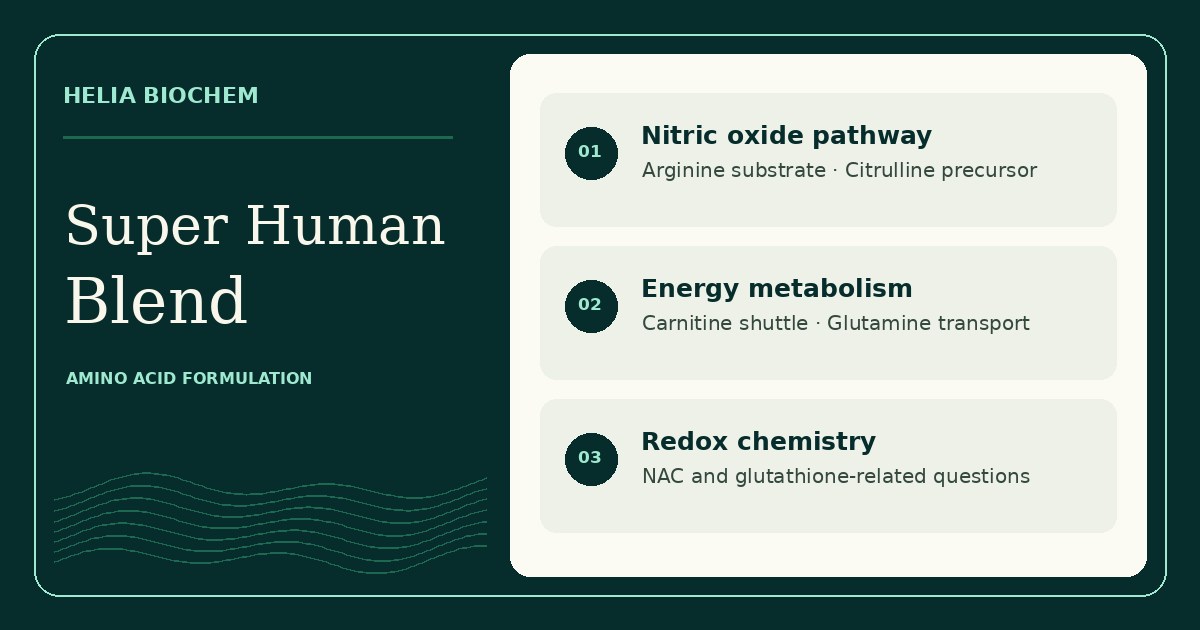
What’s in Super Human Blend?
Super Human Blend is a seller label commonly associated with nine components. One documented version lists L-arginine, L-citrulline, L-ornithine, L-carnitine, L-lysine, L-glutamine, L-proline, taurine and N-acetylcysteine (NAC). The name functions as a shorthand for this particular combination. A product label or lot document is the place to verify the ingredients of any specific sample. One public listing even contains conflicting figures for total mass, which illustrates how easily a precise-looking catalog claim can become ambiguous. Examples of public composition records and a separately published lot reference are useful for comparing the names, with details tied to each seller’s documentation.
Nitric oxide, energy metabolism and redox chemistry
The strongest case for studying the formulation starts with its ingredients. Endothelial cell experiments established L-arginine as a substrate for nitric oxide production. Citrulline can contribute to arginine synthesis, and ornithine is a distinct participant in nitrogen metabolism. Those biochemical relationships explain why the compounds are grouped together in discussions of blood flow. A nitric oxide measurement, a temporary feeling of muscle fullness and a measurable increase in exercise performance are three different outcomes.
A 2019 meta-analysis of oral citrulline found a small average effect across the high-intensity strength and power tests examined. The studies tested citrulline preparations in specific exercise settings. The work leaves open whether adding ornithine, carnitine or the remaining ingredients changes that response. The NIH review of performance supplements likewise discusses results by ingredient and exercise context.
Carnitine helps transport long-chain fatty acyl groups into mitochondria. NAC is studied for thiol chemistry and its relationship to glutathione. Lysine and proline have roles in protein composition, while glutamine carries nitrogen and taurine is an amino sulfonic acid. These functions offer different research questions. A blend study would need to specify which outcome it measures, such as blood flow, completed repetitions or a defined redox marker, and compare it with a control and relevant individual ingredients.
What the community reports can tell us
One MESO-Rx forum contributor mentioned Super Human Blend among several amino products and other compounds. The report describes a multi-product routine and the contributor’s impressions. The combination of concurrent products, weight changes and subjective observations makes it impossible to assign the perceived change to this formulation. That is an example of why an anecdote can help identify what people are curious about while leaving the central efficacy question open.
Start with the L-arginine profile, the L-citrulline profile and the N-acetylcysteine profile for individual references. For a contrasting formulation, see Super Shredder and albuterol.