Freeze-dried materials
What Is Inside a Freeze-Dried Peptide Vial?
Two vials list the same peptide amount. One has a fluffy puck and the other looks nearly empty. Which one has more peptide?
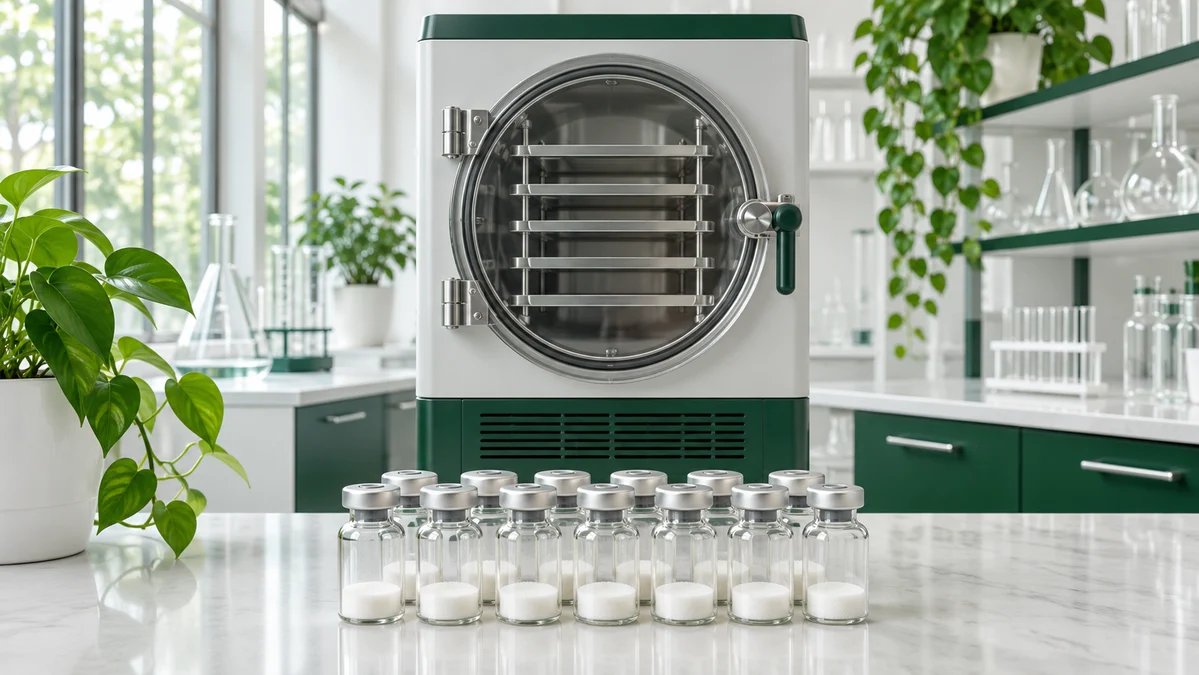
Work through the example
You cannot rank the peptide content by eye. Compare the label basis, any listed excipients and the calibrated content result for each lot. A cake can also occupy more space because its dry structure is more porous.
- Closure and headspace
- Dry matrix and formulation solids
- Lot-specific content result
Start above the cake
The space between the dried material and closure is the headspace. Its atmosphere depends on the fill and closure process. The stopper, vial and seal are part of the sample system, and their integrity matters when assessing changes during storage.
The dry material has several possible components
A cake can contain the target peptide, nonvolatile formulation ingredients, counterions, residual moisture and process- or degradation-related material. A larger cake can reflect more bulking agent, a different pore structure or a different fill composition. The lot record gives context for what was intended to be present.
Match each question to a measurement
Use a mass spectrometric identity test to compare signals with a declared target, a suitable chromatographic test to assess profile and related species, and a calibrated content assay for amount. Moisture, residual solvents and endotoxins have separate test methods. A COA is most useful when it identifies the lot, test method and result units.
Does a larger cake imply an underfilled smaller vial?
Cake volume is a visual observation. A content assay addresses the quantity of target peptide.