Research-use boundary: This monograph describes molecular and analytical research. It provides no dosing, titration or administration instructions. Materials are for lawful laboratory and in vitro research only, not for human or veterinary consumption or administration.
Molecular structure and identity
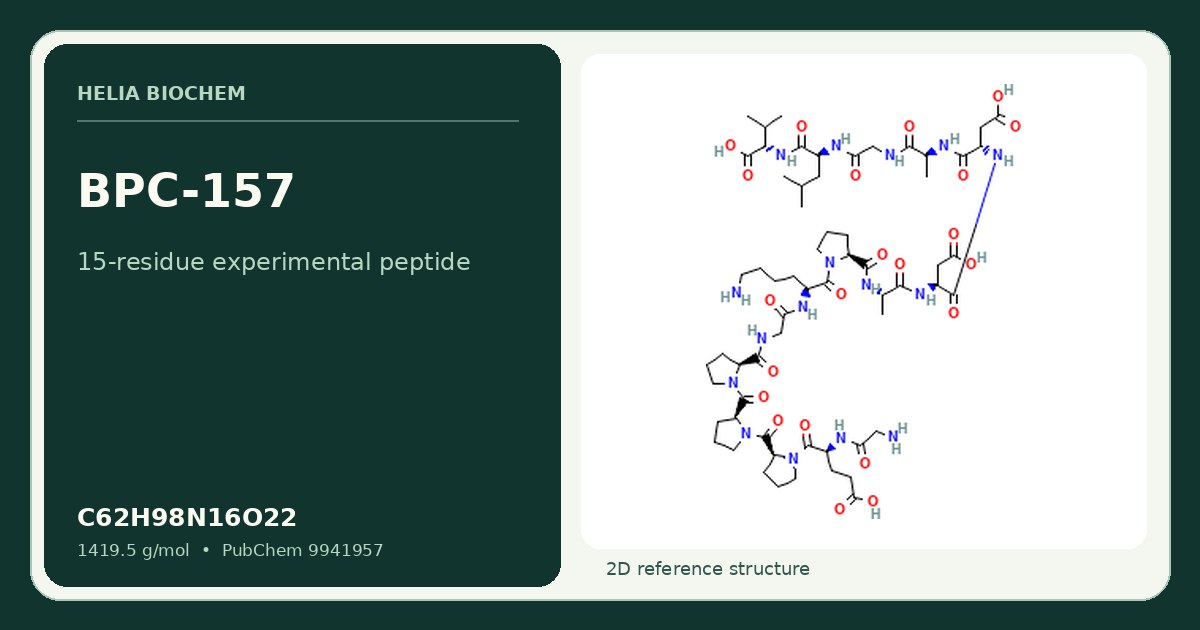
BPC-157 is a synthetic 15-residue peptide commonly represented by the sequence GEPPPGKPADDAGLV. Sequence, terminal groups and the actual chemical form define the analytical reference.
| CAS number | 137525-51-0 |
|---|---|
| Reference formula | C62H98N16O22 |
| Reference molar mass | approximately 1419.5 g/mol |
These are reference-structure values, not batch assay results. Counterions, water, formulation components and charge conventions can change the composition or mass description of a supplied material. See the linked reference and match the actual chemical form.
Receptor and biochemical research context
Cell and preclinical literature discusses nitric-oxide-related signaling, cell migration and extracellular-matrix endpoints. Those observations do not identify a universally established single receptor target. Pathway association should be distinguished from direct ligand-receptor binding.
Analytical interpretation and assay controls
Use independently measured identity and peptide content when comparing materials. Migration, viability and matrix readouts require separate controls because changes in cell number can alter apparent assay response.
Separate the analytical identity question from the functional assay question. HPLC area purity, total peptide or component content, and mass-spectrometry identity evidence are different measurements. A chromatographic percentage alone does not establish the entire weighed content, sterility, endotoxin status or functional activity.
Lyophilized storage and laboratory handling
Follow the batch-specific storage instructions and safety documentation for the exact molecular form. Keep lyophilized material sealed and protected from moisture and light; use the documented storage temperature rather than assuming a universal specification. Let a sealed cold vial equilibrate before opening to limit condensation. No compound-specific shelf life is established by this general handling guidance.
For solution work, validate solvent compatibility, pH, recovery and storage conditions in the intended assay matrix. Do not transfer an established condition from a related sequence or a different formulation without checking it. Record handling history and avoid unnecessary freeze-thaw cycling unless its effects have been assessed for the material and method.
Evidence scope and limitations
This is a literature and analytical profile, not a report of testing performed by Helia Biochem. Results are specific to the characterized molecule, model and method. Binding, pathway signaling and organism-level outcomes are different forms of evidence; none should be relabeled as another. No therapeutic benefit, supplier-specific receptor potency or material equivalence is established by this page.
Academic sources and retained bibliography
The existing bibliography is retained for provenance. Its records span different study types and may discuss subjects beyond this monograph's molecular and laboratory scope. A source link is not evidence that a supplied catalog batch was tested in that publication. Consult the original methods and exact molecular identity before relying on a result.
- Key publication or regulatory source
- Additional primary-source search or regulatory record
- Reference chemical identity and composition
Compound identity and research notes
- Classification
- 15-residue experimental peptide
- Also known as
- BPC 157
- Reference form
- BPC-157
- Molecular formula
- C62H98N16O22
- Average molar mass
- 1419.5 g/mol
- Exact mass
- 1418.70415882 Da
- Formal charge
- 0
- H-bond donors / acceptors
- 16 / 24
- InChIKey
- HEEWEZGQMLZMFE-RKGINYAYSA-N
Research context
Studies use injury models and cellular endpoints. Note the experimental species and whether the study measured migration, tissue morphology, or mechanical recovery.
Rat tendon explants and fibroblast experiments separated cell outgrowth and migration from proliferation. These model-specific endpoints are narrower than a general claim about tendon recovery.
What to verify
Sequence designations and salt names should be checked separately when comparing analytical documents.
Sources and further reading
Matching Helia research listings
Refer to the linked listing for material form and availability. Use the lot-specific COA for analytical documentation.