Research-use boundary: This monograph describes molecular and analytical research. It provides no dosing, titration or administration instructions. Materials are for lawful laboratory and in vitro research only, not for human or veterinary consumption or administration.
Molecular structure and identity
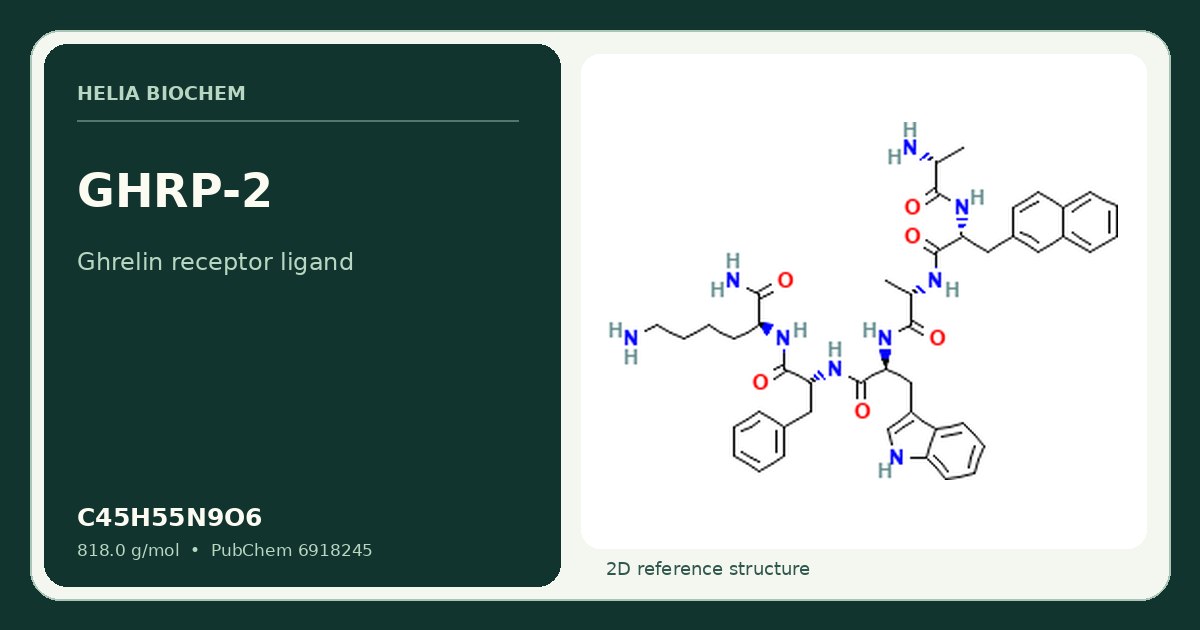
GHRP-2, also called pralmorelin, is a synthetic peptide in the ghrelin-receptor ligand class. Its residue sequence and stereochemistry are required for an unambiguous analytical assignment.
A single CAS identifier or molar mass is not asserted here without a checked, sequence-specific reference. Match the exact sequence or component list, terminal modifications, counterions and formulation to the laboratory certificate and an authoritative registry. Closely related analogs or molecular forms must not be treated as interchangeable.
Receptor and biochemical research context
The reference receptor context is GHSR-associated signaling. Ligand affinity, functional potency and the size of a downstream response should be treated as different parameters.
Analytical interpretation and assay controls
Use a matched reference and a suitable receptor-negative control. Matrix effects, sample adsorption and assay timing can complicate comparisons between laboratories.
Separate the analytical identity question from the functional assay question. HPLC area purity, total peptide or component content, and mass-spectrometry identity evidence are different measurements. A chromatographic percentage alone does not establish the entire weighed content, sterility, endotoxin status or functional activity.
Lyophilized storage and laboratory handling
Follow the batch-specific storage instructions and safety documentation for the exact molecular form. Keep lyophilized material sealed and protected from moisture and light; use the documented storage temperature rather than assuming a universal specification. Let a sealed cold vial equilibrate before opening to limit condensation. No compound-specific shelf life is established by this general handling guidance.
For solution work, validate solvent compatibility, pH, recovery and storage conditions in the intended assay matrix. Do not transfer an established condition from a related sequence or a different formulation without checking it. Record handling history and avoid unnecessary freeze-thaw cycling unless its effects have been assessed for the material and method.
Evidence scope and limitations
This is a literature and analytical profile, not a report of testing performed by Helia Biochem. Results are specific to the characterized molecule, model and method. Binding, pathway signaling and organism-level outcomes are different forms of evidence; none should be relabeled as another. No therapeutic benefit, supplier-specific receptor potency or material equivalence is established by this page.
Academic sources and retained bibliography
The existing bibliography is retained for provenance. Its records span different study types and may discuss subjects beyond this monograph's molecular and laboratory scope. A source link is not evidence that a supplied catalog batch was tested in that publication. Consult the original methods and exact molecular identity before relying on a result.
Compound identity and research notes
- Classification
- Ghrelin receptor ligand
- Also known as
- Pralmorelin; KP-102
- Reference form
- GHRP-2
- Molecular formula
- C45H55N9O6
- Average molar mass
- 818.0 g/mol
- Exact mass
- 817.42753051 Da
- Formal charge
- 0
- H-bond donors / acceptors
- 9 / 8
- InChIKey
- HRNLPPBUBKMZMT-RDRUQFPZSA-N
Research context
Growth hormone release and receptor activation are different endpoints. Check the assay system and comparator when reading GHRP-2 studies.
The investigators used analytical measurements to identify GHRP-2 in a complex product. Identification does not establish activity or purity of a different preparation.
What to verify
Keep GHRP-2 separate from GHRP-6 even when both appear under the same secretagogue class.