Research-use boundary: This monograph describes molecular and analytical research. It provides no dosing, titration or administration instructions. Materials are for lawful laboratory and in vitro research only, not for human or veterinary consumption or administration.
Molecular structure and identity
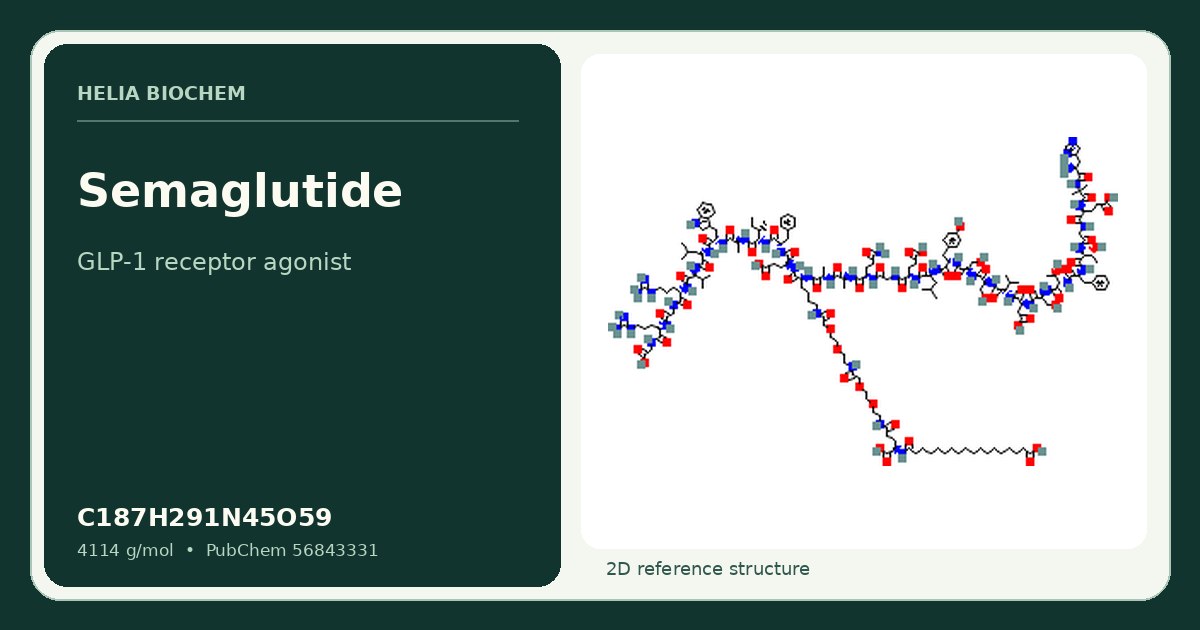
Semaglutide is a modified GLP-1-related peptide with a lipid-containing side chain. Substituted residues and linker chemistry are part of the reference molecular structure.
A single CAS identifier or molar mass is not asserted here without a checked, sequence-specific reference. Match the exact sequence or component list, terminal modifications, counterions and formulation to the laboratory certificate and an authoritative registry. Closely related analogs or molecular forms must not be treated as interchangeable.
Receptor and biochemical research context
Receptor assays investigate GLP-1R-mediated signaling. Protein binding, receptor density and signal amplification can influence apparent potency, so an assay response must be interpreted with its own experimental controls.
Analytical interpretation and assay controls
Distinguish intact reference material from oxidized, deamidated or incompletely modified species using a suitable analytical method. No material-specific receptor potency is asserted without testing.
Separate the analytical identity question from the functional assay question. HPLC area purity, total peptide or component content, and mass-spectrometry identity evidence are different measurements. A chromatographic percentage alone does not establish the entire weighed content, sterility, endotoxin status or functional activity.
Lyophilized storage and laboratory handling
Follow the batch-specific storage instructions and safety documentation for the exact molecular form. Keep lyophilized material sealed and protected from moisture and light; use the documented storage temperature rather than assuming a universal specification. Let a sealed cold vial equilibrate before opening to limit condensation. No compound-specific shelf life is established by this general handling guidance.
For solution work, validate solvent compatibility, pH, recovery and storage conditions in the intended assay matrix. Do not transfer an established condition from a related sequence or a different formulation without checking it. Record handling history and avoid unnecessary freeze-thaw cycling unless its effects have been assessed for the material and method.
Evidence scope and limitations
This is a literature and analytical profile, not a report of testing performed by Helia Biochem. Results are specific to the characterized molecule, model and method. Binding, pathway signaling and organism-level outcomes are different forms of evidence; none should be relabeled as another. No therapeutic benefit, supplier-specific receptor potency or material equivalence is established by this page.
Academic sources and retained bibliography
The existing bibliography is retained for provenance. Its records span different study types and may discuss subjects beyond this monograph's molecular and laboratory scope. A source link is not evidence that a supplied catalog batch was tested in that publication. Consult the original methods and exact molecular identity before relying on a result.
Compound identity and research notes
- Classification
- GLP-1 receptor agonist
- Also known as
- GLP-1 analog
- Reference form
- Semaglutide
- Molecular formula
- C187H291N45O59
- Average molar mass
- 4114 g/mol
- Exact mass
- 4112.1187318 Da
- Formal charge
- 0
- H-bond donors / acceptors
- 57 / 63
- InChIKey
- DLSWIYLPEUIQAV-CCUURXOWSA-N
Research context
Semaglutide is studied through GLP-1 receptor signaling. Its lipid modification is relevant to molecular identification and handling discussions.
This is a formulation-specific outcomes study. It does not establish identity or equivalence for materials labeled only by the active ingredient name.
What to verify
When comparing with dual and triple agonists, list the receptor and endpoint used in each experiment.