Shipping and storage
Peptide Shipping in Warm Conditions
The parcel is warm when you bring it inside. The vial is sealed, the gel pack has thawed, and the delivery scan is two hours old. What can you actually conclude?
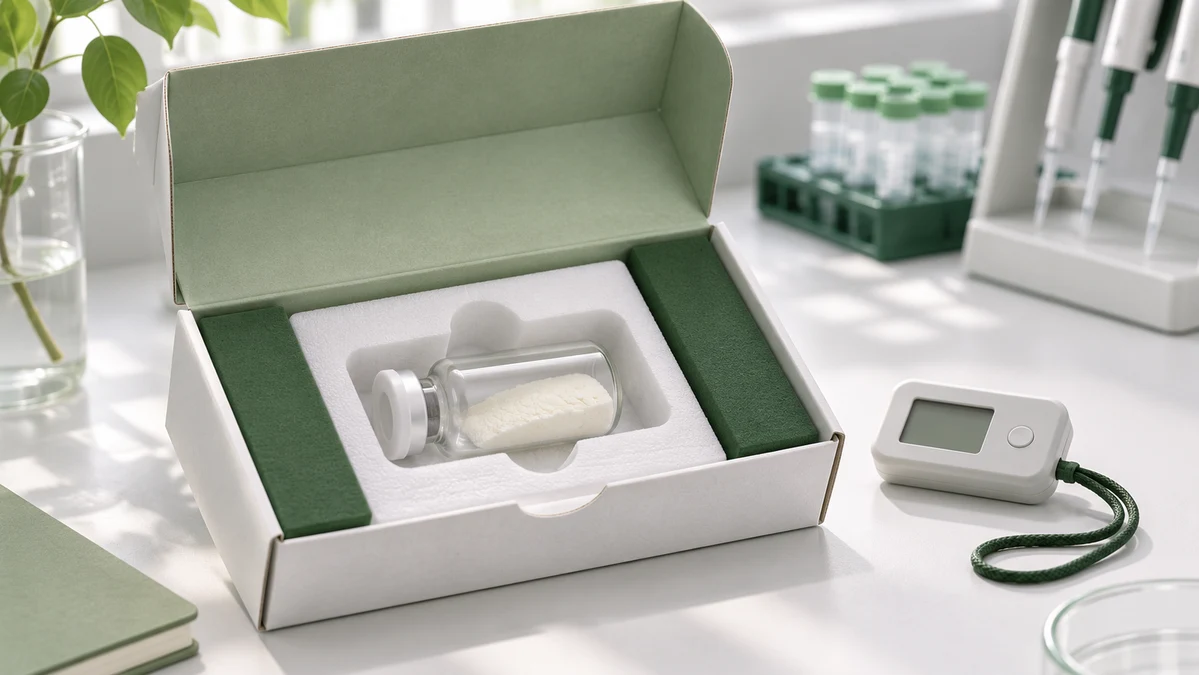
Work through the example
The delivery scan dates one event. The gel pack tells you something about the package when you opened it. Neither supplies a temperature history for the vial. Start by recording both observations and asking for the stability evidence that applies to this material.
- Where temperature was measured
- How long exposure lasted
- What the product study covered
Start with the exposure record
Temperature, time and physical state affect how an excursion should be assessed. A delivery scan gives the time a package was marked delivered. Shipment records or a logger can add details about the path and duration of exposure.
Compare with the study conditions
A study on a sealed dry vial has a specific formulation, container and endpoint. The results apply most directly when those conditions match the receiving laboratory’s material. Compare intact peptide, related substances and any other acceptance measurements documented in the study.
Document your receiving decision
Record the lot, packaging condition, available time and temperature information, and any damage or signs of compromised closure. Use the supplier’s lot information and your institutional receiving procedure.
Separate the porch from the product
Think of the carton, insert and glass vial as three objects that warm at different rates. A dark outer carton in direct sun may warm before the protected contents. Even an air logger beside the parcel measures a different object than a sensor placed in a representative shipping configuration.
Why a dry sample behaves differently
In a dry cake, reduced water and molecular mobility often slow pathways that proceed more readily in solution. Dry materials still contain residual moisture, and their behavior changes with formulation. The treated sample, its physical state and its container all need to match the scope of the evidence.
What a study should tell you
Look for the exact material and packaging, a recorded time-temperature profile, and a defined comparison with an unstressed control. A result is easier to interpret when the acceptance criteria were set before stress testing. A single peak-area number after exposure gives less information than a matched profile with content and related-substance measurements.
What might change while the vial still looks normal
Depending on the molecule, chemical changes can include oxidation, cleavage or changes involving disulfide bonds. Related species may be detectable by chromatography or mass spectrometry even when the cake looks normal. Physical changes such as cracking or shrinkage deserve documentation but cannot identify a degradation product.
When to put the lot on hold
If the seal appears compromised, if a recorded exposure exceeds supported conditions, or if the exposure history is insufficient for your acceptance criteria, set the lot aside under its documented storage conditions and record the uncertainty. Ask for product-specific evidence before releasing it into an experiment.
Three situations, three different decisions
| What you found | What to check next |
|---|---|
| Warm carton, no logger | Record delivery and pickup times. Ask whether the available shipping evidence covers a plausible exposure. |
| Logged excursion, seal intact | Compare the observed duration and temperature with the tested profile and acceptance limits for this formulation. |
| Cracked vial or displaced stopper | Document the container issue and follow the laboratory’s hold procedure. A thermal study does not resolve loss of container integrity. |
Would a two-hour excursion justify storing the vial warm for a month?
A shipping study answers for its own duration and conditions. Long-term storage requires a separate body of evidence.