 American Owned
No single experiment answers every retatrutide stability question. Each PTDS study used a different product, condition, interval or comparison. Read together, they show a consistent distinction: reconstituted solutions should be evaluated mainly by recovered mass, while sealed lyophilized powder is better assessed by purity.
The study designs, funding and source data came from members of PTDS, a crowdsourced research-peptide testing community. PepRecon Research organized and originally published the material. The original charts below are preserved with their PepRecon branding.
Why recovered mass matters more than purity in solution
Before HPLC analysis, laboratories commonly filter a solution to protect the instrument. That step can remove insoluble aggregates and particulate degradation products. The reported purity then describes only the material that remained soluble and passed through the filter.
A reconstituted sample can therefore lose recoverable peptide while still reporting excellent purity. For aqueous stability, recovered mass or total peptide is the more useful signal when considered alongside purity. For sealed dry powder, where solution aggregation is absent, a purity change is more informative about chemical degradation.
Reconstituted and refrigerated
Four datasets followed reconstituted material under controlled refrigeration. Seven of eight vials changed gradually; one SSA vial failed dramatically. The pattern supports refrigeration as the most consistent tested condition, but it also shows why a single vial cannot establish a universal storage rule.
| Test | Product | Diluent | Intervals | Key endpoint |
|---|---|---|---|---|
| 555 | SSA 30 mg | Bacteriostatic water | 0 / 30 / 45 / 60 days | Purity remained above 99.4% |
| 683 | J5-ZYH 60 mg | Bacteriostatic water | 0 / 30 / 60 / 90 days | 2.4% mass loss |
| 616 | GBBB-ZJC 60 mg, two vials | Bacteriostatic water | 0 / 30 / 45 / 60 / 90 days | Approximately 9–10% mass loss |
| 473 | TCI, XYX and SSA | Bacteriostatic water | 0 / 30 / 60 / 90 days | Two held; one severe outlier |
Test 616 illustrates why purity alone can be misleading. Its two vials lost about 9% of recovered mass over 90 days while purity stayed near 99.6%. That combination is consistent with material aggregating, adsorbing to the vial or otherwise failing to reach the detector.
The diluent matters: bacteriostatic versus ultrapure water
Test 683 was one of the cleaner comparisons. Two vials from the same J5-ZYH kit were prepared side by side, stored in the same refrigerator and tested on the same schedule. The principal variable was the diluent.
| Diluent | Total peptide, day 0 | Total peptide, day 90 | Change |
|---|---|---|---|
| Bacteriostatic water | 64.98 mg | 63.40 mg | −2.4% |
| Ultrapure water | 73.48 mg | 67.69 mg | −7.9% |
This same-kit comparison associated bacteriostatic water with roughly one-third the peptide loss seen with ultrapure water. It is still a two-vial experiment and does not establish sterility or a universal formulation rule.
Room temperature: faster and more variable
Test 715 held two bacteriostatic-water solutions at room temperature for 45 days. One product changed little, while the other lost nearly 9% of recovered mass.
| Product | Mass, day 0 | Mass, day 45 | Change |
|---|---|---|---|
| J5-ZYH 60 mg | 77.11 mg | 75.91 mg | −1.6% |
| QSC 15 mg | 14.29 mg | 13.04 mg | −8.7% |
The room-temperature result was not uniformly catastrophic, but it was less predictable than refrigeration. The purity readings also fluctuated enough that recovered mass provides the more coherent signal.
Freezing the reconstituted solution did not improve retention
Tests 616 and 624 used the same GBBB-ZJC 60 mg product. The frozen and freeze–thaw arms lost 13–14% of recovered mass in 45 days; continuously refrigerated vials lost about 9–10% over 90 days.
| Handling | Window | Mass retained |
|---|---|---|
| Continuous refrigeration, vial 1 | 90 days | 91.0% |
| Continuous refrigeration, vial 2 | 90 days | 90.4% |
| Freeze, thaw and refrigerate | 45 days | 85.6% |
| Repeated freeze–thaw cycling | 45 days | 86.6% |
The SSA outlier: when one vial fails
Test 473 included three refrigerated vials. TCI and XYX behaved similarly to the other refrigerated samples, but the SSA vial fell from 98.17% to 57.0% purity and from 16.61 mg to 9.26 mg recovered mass by day 90.
One vial cannot reveal the cause. A closure defect, contamination, formulation problem, handling issue or lot-specific instability could each contribute. A later SSA batch in Test 555 did not repeat the collapse. The responsible conclusion is narrow: rare severe single-vial failures can occur, but this dataset does not show that they are typical.
The whole reconstituted picture
Viewed together, the solution-state studies place refrigerated material prepared with bacteriostatic water at the top of the tested conditions. Room-temperature results were more variable, and freezing did not create an advantage.
As a sealed dry powder, retatrutide changed very little
Test 625 re-tested three lyophilized products after approximately 14–21 months in ordinary consumer refrigeration. Purity stayed close to the original measurements, and small increases in measured mass are best understood as analytical variation.
| Dry product | Storage interval | Mass change | Purity, baseline → follow-up |
|---|---|---|---|
| GYC R15 | ~14 months | +1.2 mg | 99.49% → 99.62% |
| QSC R15 | ~21 months | +0.5 mg | 98.32% → 99.25% |
| CA R12 | ~18 months | +0.28 mg | 99.82% → 99.67% |
Sustained 130°F heat: mass held while purity declined
Test 293 held vacuum-sealed QSC R15 dry vials at a constant 130°F for 7, 14 and 21 days. Measured mass remained near baseline, while purity declined in an approximately linear pattern.
| Exposure | Measured mass | Purity |
|---|---|---|
| Refrigerated control | 14.04 mg | 96.958% |
| 7 days at 130°F | 13.93 mg | 94.851% |
| 14 days at 130°F | 13.98 mg | 94.099% |
| 21 days at 130°F | 13.97 mg | 93.672% |
What the eight studies support
Most well-behaved vials lost only single-digit recovered mass over 60–90 days, though one severe failure occurred.
In the same-kit comparison, the bacteriostatic-water sample lost 2.4% versus 7.9% with ultrapure water.
Two products stored identically retained 98.4% and 91.3% of their starting mass after 45 days.
Frozen arms lost more recovered mass in 45 days than refrigerated arms lost in 90 days.
Three long-term samples stayed near baseline after 14–21 months.
At 130°F, mass stayed near baseline while purity declined by about 3.29 percentage points over 21 days.
Evidence-based conclusion: the complete dataset describes retatrutide as comparatively durable, especially while sealed and lyophilized. After reconstitution, refrigeration produced the most consistent results among the tested conditions, but product, lot and vial variability remained important. These studies do not establish sterility or a universal beyond-use date.
Four core stability findings: laboratory questions
How much retatrutide was retained in refrigerated bacteriostatic water?
In PTDS Test 683, the bacteriostatic-water sample retained 97.6% of its day-0 total peptide after 90 days, compared with 92.1% for the ultrapure-water sample from the same kit. This two-vial comparison does not establish a universal storage rule, sterility or a result for a Helia batch.
How variable were the room-temperature results?
In PTDS Test 715, two bacteriostatic-water solutions retained 98.4% and 91.3% of their starting recovered mass after 45 days at room temperature. The difference shows sample-specific variability under the tested conditions; it does not establish a general room-temperature shelf life.
What recovered-mass loss was observed after freezing or freeze-thaw handling?
In the same-product comparison using PTDS Tests 616 and 624, the frozen/thawed and repeated freeze-thaw arms retained 85.6% and 86.6% of recovered mass after 45 days, corresponding to losses of 14.4% and 13.4%. Continuously refrigerated arms retained 91.0% and 90.4% after 90 days. The intervals differ, and these observations concern reconstituted solution, not sealed lyophilized powder.
What did the 14–21 month lyophilized dry-powder study find?
In PTDS Test 625, three sealed lyophilized products stored in ordinary consumer refrigeration remained close to their baseline purity measurements after approximately 14–21 months. Small measured mass increases were interpreted as analytical variation. These sample-specific observations do not establish sterility, a universal expiration date or a validated shelf life for Helia material.
Limitations
- Mostly single-vial conditions: most arms cannot separate treatment effects from vial-to-vial variation.
- Different experiments: vendors, lots, intervals and study questions varied.
- Mass and purity answer different questions: pre-run filtration can make solution purity look better than total recovery.
- Measurement variation is visible: small upward mass movements and fluctuating purity readings should not be overinterpreted.
- Vendor and lot specificity: results do not automatically apply to another supplier or Helia’s Triple Agonist (Retatrutide) material.
- No sterility conclusion: chemical stability does not establish microbiological safety.
The whole study in one card
Research conducted by PTDS. Originally published by PepRecon Research. Thank you to the PTDS community for designing and funding the studies and to PepRecon Research for organizing and publishing the full dataset and graphics.
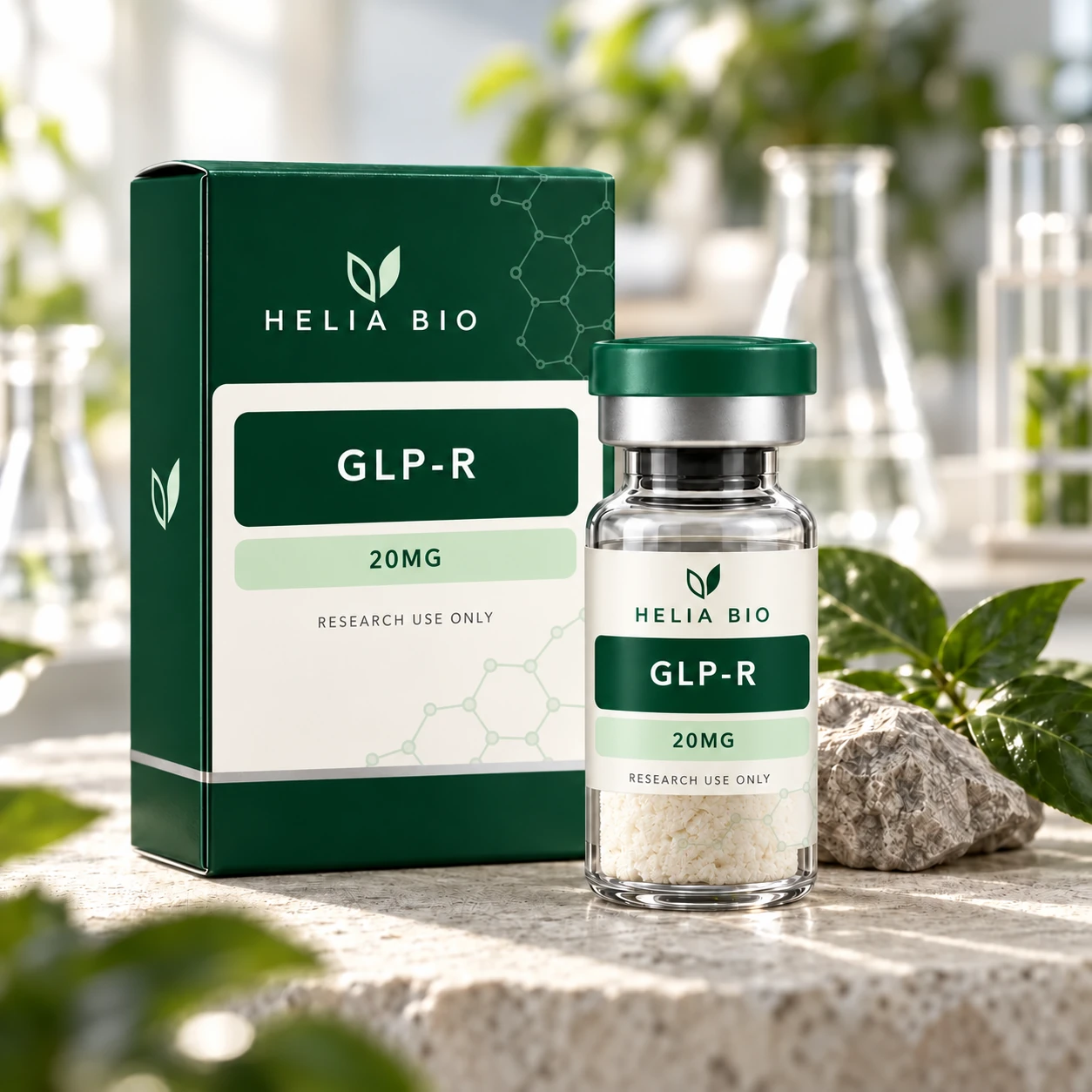
Featured Helia research material
Triple Agonist (Retatrutide)
Compare 10-vial research kits by strength per vial and review the matching batch documentation. The PTDS results describe the tested samples and do not certify Helia batches. Strictly for laboratory research.